
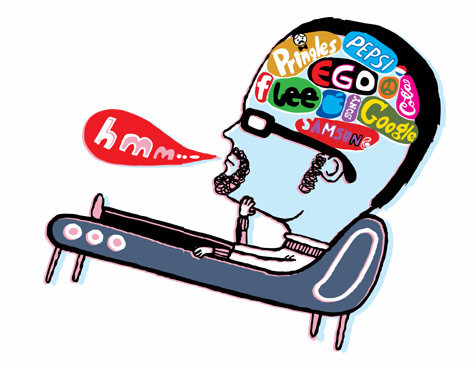
When was the last time you went to the grocery or typical drug store and decided on a particular brand for a product simply because you recognized the name? Consumers continuously go this route when shopping for different products, and psychology supports this action in a very simple way: People are more attracted (not just physically, but cognitively) to products, places, or people they are more familiar with.
Social psychologist Robert Zajonc was the first to effectively demonstrate the phenomenon that repeated exposure to a stimulus increases preferential attitude toward that stimulus (Zajonc, 2001). Since his first round of studies in the 1960’s, psychologists, along with many advertisers, have used this effect in examples of social behavior. Advertisers are most interested in this paradigm for inducing brand attitude, relatively defined as the strength of a person’s attitude toward a stimulus (brand) and the extent of their confidence in their attitude (Park, MacInnis, Priester, Eisingerich & Iacobucci, 2010). The common idea that mere exposure to a brand increases positive attitudes toward that brand, in effect, making it more likely to choose it. This mere exposure effect has been monumental in marketing and branding, especially in broadcast. If a producer is able to repeatedly show their advertisement on a highly watched network, he or she is more than likely able to increase sales for that product being shown. I would argue that advertising grew from this very simple, but very concrete social finding. For example, every Corona commercial I see makes me automatically choose that beer when I get ready for a beach or boat day with my friends.
This leads to me to the next concept associated with mere exposure, but on a different level. An example given by Art Markman in his blog on PsychologyToday.com demonstrates the wide use of affective conditioning in advertising. Have you ever noticed how most laundry detergent ads contain sunshine, fresh flowers, cuddly bears and cute babies? Another part of social psychology, when we are exposed to stimuli that we view positively, we produce feelings associated with anything that is related. So when new stimuli is presented to us associated with those past experiences, the feelings attached to those experiences automatically cling onto the new stimuli. Advertisers have gotten hold of this concept and are using the ideas behind affective conditioning more and more, even without our realizing it’s there. Markman notes that this is when it is most effective. So the next time you see an ad for a product that makes you feel certain ways, you may find yourself either going out and choosing that brand more, or staying far away from it.
There are many, many more ways that modern advertising is adopting fundamental psychological concepts, and they should. What better a way to increase your sales than by understanding what the target audience really wants.
 C.K.
C.K. 